Huwebes, Setyembre 29, 2011

You Get What You Pay For With SEO, Just Like With Everything Else

You Get What You Pay For With SEO, Just Like With Everything Else

As SEO Hawaii found this article, this strucks us most because we all know that everyone of us are wondering how to SEO the website and getting paid more. So, here it is now the key. All you have to do is to read this article to find your answer.

Perhaps the best explanation about "Cheap SEO" that I've seen.

“How much does a website cost?” and other pricing questions

“How much does a website cost?” and other pricing questions

Hello everyone! SEO Hawaii found this website very interesting to those who knew about it because many of us including SEO Hawaii are sometimes having hard time answering this question. Sometimes, we used to post on a forum just to find an answer to this question. Here it is now, You will lost a chance if you won't read it.

40 designers weight in on their pricing on design work for logos, homepages, websites, and mobile & web apps,

How Marketers Can Connect with the 3 Mindsets of Search [STUDY]

How Marketers Can Connect with the 3 Mindsets of Search [STUDY]

SEO Hawaii reposted this article because SEO Hawaii would like to help everyone regarding this topic.

A recently released research study by About.com and Latitude identifies three distinct mindsets in search and offers insight into how marketers can offer ads and align them with content that better appeals to each mindset. Three Mindsets of Search...

Blogger Adds 7 Dynamic Views for Easier Content Discovery

"Google emphasizes that these new templates are built in the most current web code, and thus load "40 percent faster than traditional templates." Additionally, media content and older posts are surfaced, giving your older work an extra shot at attention." This what SEO Hawaii found in the article that really structs me. If you are curious why, you may find in this article the kay to your curiousity.

Blogger has released seven new "dynamic view" templates. These templates speed up the content's load time and organize your blog's content in a number of visually rich ways to aid content discovery. About the Templates Google emphasizes that t...

How You Can Build Links Easily With Product Reviews

Maybe some of you just like SEO Hawaii are wondering about this topic. We all know that SEO has been a big issue since then because it is one way of bringing more traffic to your site. In many instances like seminars and etc, we know that it is a great deal.

The art of building links to increase search rankings has been a big topic in the SEO community for a long time. This always seems to be the topic of discussion at the Search Engine Optimization meetings I attend each month. Everyone seems to be looking for the latest and greatest ways to increase...


Only 7% Of SEOs Don't Provide Ranking Reports

SEO Hawaii found this article and found out in this article that only 7 percent out of 100 percent of SEOs do not provide ranking reports.

We polled our readers, mostly SEOs...

How to Compute Your Website`s Value

This article will really help you to learn more about SEOs. Just like with SEO Hawaii we will be learning alot of things regarding SEO in this matter. This will really help you determined the true value of your website.

One of the things that you might think important as a website owner is knowing the value of your website, in dollars. This might sound like an easy task, since there are lots of calculators on the web that can be used to compute your website value. Sadly, they are all inaccurate for depicting your website's true worth. Lots of shortcuts in the calculation and too much generalization won't give you a very reliable estimate of your website's value. Thus, the only way you can determine your website's true worth or value is through manual computation and analysis of your website. You do not need t...

Nine Ways to be a Competitive SEO

This article entitled "Nine Ways to be a Competitive SEO" talks about the optional strategies that can help us attract searchers on gain more traffic to our website. Just like SEO Hawaii who have been searching different tools and strategies to compete with other top performing SEO sites, you would probably do the same.

Some great tips on a different way of thinking to show that your SEO strategies are up there with the best of them!

Why So Many Blogs Fail (And What to Do About It)

"Blogging is not just one of those strategies that needs to be tailored to specific situations: it’s a strategy that, by default, will fail." This is from one of the lines in the article and SEO Hawaii thinks about it and is agree to what it says.

It’s a safe bet that right this minute, someone, somewhere, is advising a small business owner to start a blog. And it’s an equally safe bet that this blog will be a waste of time. Blogging used to be an effective strategy, but its current popularity is a holdover. And case study after...

Miyerkules, Setyembre 28, 2011

Tomorrow's Google Webmaster Hangout Details

Hello everyone! The Search Engine Optimization Hawaii found this article just today. And here it comes, it is being reposted for everbody's information regarding the activity of the Google tomorrow. As far as your concerned, Google will be conduction a forum like wherein you can ask questions regarding SEO and etc.

Google is hosting yet another "Webmaster Hangout" tomorrow. This time it is at 11AM UK time for one hour...

Google+ Reaches 50 Million Users


google plus


According to what Social Media Consultant's research, this article talks about how does Google excels on their what they called an "invitation only". Google doesn't expect that there will be many users that will be signing up on their new Social Media.

Last Tuesday, the Google Blog announced that Google+, which had been “invitation only,” was changing to “open access.” According to data from Experian Hitwise, since Google+ made the service publically available, Google has seen a 1269% increase in traffic to the social networking site. In the week following its public launch, Google+ increased to 15 million US visitors and increased its ranking to the 8th most visited social networking site. However, during the same time period, Facebook continued to dominate Google+ with well over 1.7 billion visits.

Google+ achieved 10 million users within two weeks of launching and within a month the social site had over 25 million users. To put these figures into perspective, it took Facebook three years and Twitter 30 months to reach the 25 million user milestone. However, Google does have the distinct advantage of an established network of over one billion users. Paul Allen, the self-proclaimed “unofficial statistician” for Google+, said the following regarding Google leveraging its dominant online presence to quickly generate signups:

“By integrating +1 and Circles (targeted sharing) and other Google+ functionality into its Chrome browser, Android phones (and tablets), Gmail, Google Reader, Blogger, Google Photos, and other properties, Google+ will give its more than one billion users repeated chances to sign up for and use the functionality of Google+.”

Allen also stated that his data suggests Google+ has passed 50 million users and is acquiring new users at a rate of two million per day. When compared to Google+, Facebook currently has 16 times as many users and over 100 times as much traffic. However, the rapid growth rate, innovative features, and Google’s commitment to the social network’s success indicate Google+ will have Facebook’s attention for the foreseeable future.

SEO: Success Through Delegation & Integration

This SEO article just like with SEO Hawaii will give you further knowledge regarding SEO. In this case, it will enhance you on your part.

I’m a big fan of delegation – at least that’s what my last review decided. We are forever talking in SEO about how best to integrate SEO activity with the work of other departments, from PPC to display to social media to PR. Ev...

Martes, Setyembre 27, 2011

Google Analytics Gets OK’d In German State

According to what SEO Hawaii read in this article, this talks about the agreement between the Google and the country of Hamburg, Germany to continue using their Google analytics.

Google has reached agreement with privacy officials in the German state of Hamburg that will allow website owners to continue using Google Analytics. The accord comes months after Hamburg officials threatened to fine German businesses that used Google Analytics. As part of the agreement, Google has...

Social Media Analytics: 4 Tools You May Have Been Missing

SEO Hawaii finds this article very interesting. Don't close your web unless you read this article. You will lose alot if you did.

If you’re not using these tools to measure social media, you’re getting it wrong. These  tools enable you to measure social media properly, in a way that will lead to building stronger relationships, getting more traffic and converting more. What Social Media Analytics Includes. . .

A Simple Guide to What Makes a Good Link

For those who really wants to get more traffic, SEO Hawaii found an article that is suitable to this for your questions. This article talks about the bad and the good SEO that you will be going through. For sure, this will help you benefit alot to gain more traffic to your website.

Our industry is by nature quite active and vocal online. Hundreds of thousands of SEO blogs exist, with a wide range in quality, originality, and novelty of content. To those of us practicing SEO on a daily basis, a lot of content may be summarily...

Facebook Kills Rumor, Announces ‘Facebook Will Always Be Free’

Hello everybody! Social Media Consultant will be posting this article to help everybody reveal the truth base on what we have read.


Perhaps you saw a friend post a message over the weekend that Facebook is planning to charge for “gold,” “silver” and “bronze” membership services. This rumor became so widespread, Facebook was forced to address...

Basic SEO for Facebook Fan Pages

SEO Hawaii have undergone already many different forum questions regarding this topic. Now, there is already an answer for you questions. This article found by SEO Hawaii will really helps you alot that many SEO specialist can never answered.

Many have tried, and failed, to write a good post about how to SEO a Facebook fan page. For example, optimizing the filename of your profile picture is one popular piece of advice that doesn’t really matter, considering Facebook just renam...

Lunes, Setyembre 26, 2011

Google News Launches “Standout” Tag for Featured Content

Hello everyone! SEO Hawaii find this article very interesting. It is very important to read it. Don't close it without reading first because it will surely help you in your SEO.


Today at the Online News Association conference, Google introduced a new link rel attribute that news organizations can use to mark their best work. You can mark up to seven pieces of content per week. Google News will use this information as a signal for labeling news stories as...

Google Logo Celebrates Jim Henson’s 75th Birthday

Hello everyone! SEO Hawaii is here to give an update regarding the new logo of the Google. This logo is basically a theme base on Jim Henson's birthday.

A new Google logo that’s on the company’s home page today celebrates what would have been Jim Henson’s 75th birthday. The logo features six new Muppet characters, each of which can be controlled as if you’re the puppeteer. A couple of the Muppets do special actions when you...

Google+ Gains Nearly 10 Million Users In First 2 Days Of Being Open To The P...

Google Rocks their first Social Media which they called the Google+ in just 2 days only. Many people including the SEO Hawaii are already a member of this Google+.

A Google+ post by Paul Allen, founder of ancestry.com and a self-proclaimed “unofficial Google+ statistician, shows significant growth of Google’s social network since opening to the public.   These growth rates were only first seen during the first few weeks of field testing when the...

White Hat SEO Might Get You Beat Up

SEO Hawaii come up with a summary of this article between the Black Hat SEO and the White Hat SEO. This article really talks the advantages and disadvantages of both parties. Therefore, base on SEO Hawaii's impressions, we rather do the proper steps of SEO for a long term purposes.


An interesting parable about focusing on the sites you control and not the ones you don't.

Biyernes, Setyembre 23, 2011

Google Announces Reclassification Of Backlinks

Google Announces Reclassification Of Backlinks


In this artilce, SEO Hawaii looks forward to post it because we know that this is one way of optimizing site thus, achieving success to your website. This article really helps you alot in order to find your way going to success.

subdomain and subfolder linking

Last week Google announced a change to the way they classify internal and external links in Webmaster Tools. The update shoul

dn’t change the number of links, but should report your links in a more accurate way in regards to where they are coming from.

In the past, links from subdomains (ie: example.seo.com) were classified as external links. Even a link from the non www version of your site was classified as external. With the changes, links from these types of domains will now be considered internal links, as long as you also own the root domain.

With this change you may notice your total number of external links go down, but this is only because some of your links that were previously classified as external are now being classified as internal. Your total number of links should remain the same.

image by TechWyse

Reclassification of Backlink by Google


Site Search Analytics: What Your Customers Want...In Their Own Words


SEO Hawaii posted this article here inform everybody especially those website promoters so that they could apply this article information in their own websites.

When people come to your site, it can be really hard to know why they are there.  The truth is the average conversion rate on e-commerce sites is only around 2-3%...and that's on sites that are specifically built to sell stuff.  So, what happens to the other 97%?  Why were they there?  Did they find what they were looking for?  If not, why not?  Is the content they are looking for even on your site?  If so, are they able to find it easily?

Keywords that bring users to the site via search engines can help, but visitors are prone to being vague when they use search engines.  But, there's one place to go for insights into why visitors are on your site that gets overlooked.  It's a place where your site visitors become much more precise about their browsing intent.  It's your site search data.  No, not the keywords they used in search engines to find your site.  It's the phrases they used to search ON your site after they arrived.

You don't have a site search box on your site?  That's a BIG no-no.  Around 80% of Web use starts with a search. Web users even type full URLs into search boxes instead of directly into the browser address bar.  The bottom line is that people are programmed to use search on the web whether it's a search engine or business website.  They don't want to look around.  They don't want to think about how to find what they're looking for.  They want it delivered to them.  That little box on your site is MUCH more important than you think it is, as it can be a very helpful tool for growing your business outcomes.  Why?  Because it's about the best place you can go online to learn what your users want in their own words.

Search Boxes.png

Most analytics vendors now provide a feature that collects and delivers your site search data to you in a report, making it easier than ever to get your hands on this golden data.  The sad thing is that most analytics profile owners are so unaware of site search analytics that they don't even have data collection turned on (Google Analytics).  But if you are undertaking any kind of site optimization from content development to information architecture to linking structure, site search analytics can help immensely in making your website a better customer service tool to improve your bottom line.

What do your customers want?

You're Not an SEO Unless You Read This Post

You're Not an SEO Unless You Read This Post


Just like SEO Hawaii, please read this article for you to learn alot in SEO. It will surely help and benefits you.

I often write about the various jobs, skills and talents that go into optimizing a website for search engines. As the owner of a firm that specializes in website marketing strategy and leader of an awesome team of talented people, I'm quite biased as to the need and value of having such a team working on all the aspects of marketing your website.

Yet, optimizing a site isn't terribly difficult. Anybody can be taught the basics, which many already know and are implementing on their websites right now. But SEO is more than basic implementation of strategies you've read about online or on Twitter. SEO is much bigger the sum of its parts.

There are hundreds of "parts" that can play a role in an effective optimization campaign. Google looks at more than 200 "signals" alone, each with varying degrees of value and necessity. Most people who start out doing SEO soon realize there is a lot to keep up with, and it's better passed on to more capable hands.

So, just who do these capable hands belong to? Well, that depends on who you talk to. Everybody believes there is a certain level of knowledge and know-how that pre-qualifies you as an SEO. Sometimes it's fun to see what certain bottom line "requirements" are. In light of that, I put together this list of things you absolutely, certainly, necessarily or quite possibly need to know in order to qualify as an SEO.

You're not an SEO unless...

...you know HTML code

HTML is pretty much as basic as basic SEO gets. But guess what, you really don't need to know every bit of HTML to SEO a site. Does it help? Absolutely! You do need a considerable amount of HTML knowledge, but don't let anyone tell you that if you can't code an entire site by hand, you're not an SEO.

...you monitor the search engine algorithms.

SEOs need to know what the search engines are doing, but how much "monitoring" is really required? Some SEOs have almost a religious dedication to documenting, analyzing and testing every detail of an algorithm and then doing it all again when Google makes a change. Others take a big picture approach, looking at long-term SEO strategies that are not affected by every algorithm whim. Just because you don't monitor algorithms as much as someone else doesn't mean you're not an SEO.

...you read search engine patents.

I admire those who can read search engine patents and makes sense of them. These individuals have their pulse on what is possibly coming to a search engine near you. But, only possibly. Not all patents actually result in something being incorporated into the algorithm. They help you keep an eye on a possible future, but not necessarily the destined future. Just because you don't read search engine patents doesn't mean you're not an SEO.

...you build links.

Every SEO should know how to build links, but some are far better at it than others. Link building is like sales. Some people just have the gift. Every SEO should understand both basic and advanced link-building concepts and their corresponding strategies, but just because you don't do actual link building doesn't mean you're not an SEO.

...you know analytics.

Analytics is the best way to prove the value of your SEO efforts. But analytics itself isn't SEO. It's simply the reporting method. If you want to know how well your SEO is really doing, you need to learn analytics or, better yet, employ someone who can in order to analyze your website traffic data. But if you can't, that doesn't mean you're not an SEO.

...you follow search engine guidelines.

The search engine guidelines are just that: guidelines. It's smart to be sure your SEO strategies don't violate any policies that might get your site dinged. On the other hand, some of the guidelines propagated by the search engines are entirely self-serving. Being good at SEO doesn't even require that you know the guidelines, so not knowing them doesn't mean you're not an SEO.

...you can initiate "black hat" SEO strategies.

In some industries, it's very difficult to get good results unless you invest in black hat SEO strategies. If you're not in those industries, then you don't need to worry about it. And not knowing how to implement these type of strategies certainly doesn't mean you're not an SEO.

...you're a copywriter.

Copywriting skills are a must... for copywriters, not necessarily SEOs. While SEOs work with copy and should be able to craft a decent sentence and fiddle around with keyword additions into the text, the SEO can pass the job of actual copywriting to a copywriter. Not having the gift of copywriting doesn't mean you're not an SEO.

...you are a conversion optimizer.

Conversion optimization is good for SEO and necessary for a strong marketing campaign, but this isn't, strictly speaking, SEO. I'd definitely want an SEO that understands usability and persuasion before letting them make changes to my site, but not understanding conversion optimization doesn't mean you're not an SEO.

You're not an SEO unless you read this conclusion

All of the factors above help make SEO valuable. But not having any one or two of them doesn't disqualify you from being an SEO any more than not knowing how to weld a pipe precludes you from being a plumber. Valuable, but not strictly necessary.

But make no mistake, these are important, and to the degree a person has knowledge, understanding and skills in these areas is a factor into how valuable they can be as an SEO. Any one of these, however, is not a defining factor. SEOs are often best judged on the results they get. If you don't get results, then you're not an SEO.

Your are not an SEO unless you read this

Seven (Non-SEO) Tips to Having a Successful SEO Campaign


Seven (Non-SEO) Tips to Having a Successful SEO Campaign 


SEO Hawaii finds this article for you to read. I will surely help you solve your problem about your any querries in mind.

If you ask people if they want to be successful, almost unanimously, they will say yes. But if you watch what people do, you'll see that they are neither interested in, nor committed to, doing the things that are required to become successful.

Most people look for ways to "succeed" by investing the least amount of effort possible. That's why the lottery makes so much money for the government. One dollar can make you extremely rich. If you're extremely lucky.

There is absolutely nothing wrong with looking for ways to become successful with the smallest amount of effort. Luck isn't random happenstance; it's being prepared when the right opportunity comes your way! I have a motto I use quite often when I'm not working, "I worked damn hard to be this lazy!" But the key here is that I worked. I didn't just get lucky and get to be lazy because of it - I earned it.

Over the years I've busted my butt to create a successful website marketing strategy firm. It's had it's ups and downs, not to mention countless long nights and weekends. And whenever I start to feel like I can relax, it seems something comes up, and we have a new push to get us to the next level.

Successful SEO can't be done in a vacuum of search engine algorithms, social media and on-page optimization strategies. There is something even more fundamental to being successful at your SEO efforts than the knowledge needed to carry it out. These are foundational issues that, when applied, will help you not only gain the knowledge you need, but the wherewithal to grow in your success, even through difficult and dry times.

Seven steps to making sure your SEO is successful

Daily Growth: SEO requires a constant education on what the search engines are doing, how that might affect your site, and what new strategies you might need to employ. As rapidly as technology changes, your SEO knowledge yesterday won't always carry you through tomorrow.

Value the Process: SEO isn't about the destination (top rankings) but rather the process that brings constant improvement to your site. Every day you should find some ways to improve your site over yesterday's version. Look for new keywords, opportunities for new content and ways to improve the usability and persuasion processes that will increase conversions.

Don't Wait for Inspiration: Inspiration most often comes after you have started doing something. It's the work itself that inspires thoughts, ideas and strategies. If you're stuck in an SEO rut and don't know what to do next, start doing something. Look at the analtyics, read a blog or strike up a conversation with someone about the site you're working on. Do something to get the creative juices flowing.

Be Willing to Pay Now: There is a saying that says you can pay now or pay later, but you will pay. Be willing to invest heavily in SEO, especially in the early stages. In many cases SEO has to be done in large chunks rather than small bites. Be willing to invest in those large chunks of time. They often lead to greater rewards (sooner rather than) later.

Don't Focus on Your Limitations: There is no SEO in the world that can do everything greatly. Sometimes you have to know what you don't know and find qualified people to do what you can't do. Don't get stuck worrying about what you can't do and work with people who can provide strengths that compensate for your weaknesses.

Master Your Time: SEO can often be an endless process. There is always something more that can, and should, be done. In order to get anything accomplished you have to manage your time wisely. Focus on areas that will provide the best results first, then move on to other areas later. Don't get bogged down in the inessentials.

Trade Up, Not Down: When dealing with clients, developers and owners, the SEO often finds they don't get everything they want. Sometimes you have to make concessions. When you can't do everything, then look for trades that bring more value to you. Trade quantity for quality. Trade time for effectiveness. Trade rankings for conversions. You get the drift.

What's good for SEO is good for business

Each of the tips above can be applied to every area of our lives and in business, not just SEO. They are tried and true principles for success in any arena. It's just the application that varies.

SEO requires patience, determination, hard work and sometimes even sacrificing our perfect ideals. Everybody has a different definition of success. Many clients or SEOs look to rankings as the goal when they should be looking at business growth, conversions and profits. Determine what your real goals are and do what it takes to achieve them. Then you'll be successful at SEO!

Seven (Non-SEO) Tips to Having a Successful SEO Campaign

Q&A: With Online Marketing, Should I Start with SEO or PPC?

For SEO Hawaii here is the some of the most important question that we should pay attention with. In this article, if you are one of a Search Engine Optimizer you could count this as a key to your question.

When it comes to Web marketing strategies, sometimes it's difficult to know where to start. A question we hear often is:

Should I start marketing my website with search engine optimization (SEO) or pay-per-click (PPC)?

The response from our three in-house experts was unanimous! You need both. Here's why...

Stoney (@StoneyD): While both SEO and PPC results are displayed on the same search results page, they operate very differently (and independently) from each other. PPC can be set up much quicker and get results sooner than SEO can. But don't let that make you think you'll "instantly" get ROI out of it. PPC takes optimization before profits are secure. SEO, on the other hand takes along longer to work. My suggestion is, if you can afford it, get started on PPC right away to start bringing in profits sooner. While the PPC campaign improves, be working on the optimization of your website, targeting keywords, building links, growing your social base and improving conversions.

Question-Mark-200x300.pngCraig (@craiggeis): SEO takes time to gain ground, so starting asap is important. SEO also improves site usability because it takes visitors into account. You need PPC because it helps fill the traffic void while SEO is ramping up. Together they generate a synergy effect on visibility and conversions.

Mike (@mflem25): There are going to be keywords up front that you know you want to rank for. Begin both PPC and SEO for those keywords immediately. Your long term goal is to dominate search results pages for keywords that work at growing your business. The best way to do that is to have listings through both PPC and SEO. Each reinforces the other, resulting in overall lift of visitors and conversions. In fact, with the rise of universal search (including product listings, local listings, product extensions and the like), you can have more than two options for the searcher on a page, all with different messages.

After you've ranked well for keywords, you know should be hitting home runs. Use PPC experiment data as intelligence for where to go next and how to proceed. Since SEO typically takes 6-12 months to begin seeing significant results (if done right), here are some advantages that PPC offers that make it a channel you don't ever want to leave behind.

Immediacy


  1. Results - You don't have to wait to see if a keyword, landing page, message or promotion will work. You know what is going on as soon as you get statistically significant data.

  2. Feedback - You're target customers immediately tell you what keywords they are using to find what you offer, allowing you to customize the conversion process for their needs.
  3. Control


    1. Performance - Improvements in performance can be made instantaneously.

    2. Keywords - You decide exactly what keywords you show up for. With SEO, pages can show for many unqualified keywords. Also, how about the keywords you aren't ranking organically for yet, but that are important to your business? You can have a presence there at a profitable ROI.

    3. Landing Pages - You decide exactly what landing pages prospects using specific keywords land on. With SEO, visitors on those same keywords may land on a variety of site pages.

    4. Location - You are able to geo-target your ads to customers to make them more relevant. With SEO, there is no geo-targeting function.

    5. Position - You can decide to pay for any position on the page. Although it's not necessarily desired, you CAN test to find out what an optimal position is for you and stay there.

    6. Spend - You can immediately raise and lower your bids or budget depending on results and other outside factors of your business.

    7. Ad Messages - You can immediately test ad messages to see what resonates with your prospects better.

    8. Promotions - If you want to run a promotion, you can immediately gather targeted customers to that promotion.

    9. Special Situations - If something happens where you need to get a message out on specific keywords right away, PPC gives you this option.
    10. Testing


      1. Keywords - Which keywords work and which don't? You want to know before you optimize your site organically for them. PPC gives the added ROI of market intelligence.

      2. Landing Pages - Which landing pages work to convert which keyword markets? PPC gives this too.

      3. Ad Messages - Testing ads is immediate and easy to do, giving you results based on data, not opinion.

Content Optimization Tutorial: How to SEO your Content for Rankings

Many People finds SEO such a difficult task. They have problems in figuring out the proper ways of optimizing their site nor their client's website. Now, SEO Hawaii finds this article for your own benefit. This will ensure you that after this article, it will benefits you and you could also gain knowledge.

A lot of people have trouble figuring out the "correct" way to optimize content for keywords. Copywriters are resistant to having to use particular words to get their point across and, rightfully, don't want their content cluttered with dumb sounding "keyword" phrases.

It's unfortunate that "optimized content" has somehow come to mean something other than "marketing content" for a website.

Optimizing content for search engine rankings is first and foremost writing marketing copy for your visitors. The key difference is we know what (key) words your visitors are looking for, and it's just a matter of crafting the content to accommodate their interests.

When optimizing a page, we generally like to have something to work with. Most clients provide us some initial verbiage to use as a starting point. This information can help us better understand the client's perspective on their products or services and is an excellent resource for the finalized product.

Of course, this is only one resource. We also like to have a good understanding of the client's philosophies, hot points, key selling propositions, etc. All these get worked into the content as needed.

Keep Your Focus on Keywords

While optimized content is primarily sales and marketing driven, it must also use the keywords that searchers are using to find your products or services. There are three different types of "keywords" we try to work into every optimized page: core terms, supporting words, and related words.

Core Terms

Core terms are generally the subject of a page. A core term is a two, sometimes three-word phrase that summarizes what that page is focused on. All other phrases will be based on this primary phrase.

Examples:


  • motorcycle battery

  • dog collar

  • plastic card

  • kids clothes
  • Supporting Phrases

    Supporting phrases are essentially the core term plus one or two other "qualifying words" that create a unique phrase. Generally, any single core term can have 100-1000 supporting phrases, but we like to focus a page on 10-20 of these phrases that are tightly related to each other.

    Examples:


  • motorcycle battery charger

  • bark control dog collar

  • plastic business card manufacturer

  • kids ski clothes

  • These additional supporting words (charger, bark control, business, ski) can be used liberally within the content (keeping quality a priority). They do not necessarily need to be used within the full phrase, but should be when possible and it makes sense to do so. The key is to make sure these words are used on the page in some form or another.

    Related Words

    Related words are words and phrases that are generally found on pages focused on this particular topic. They may or may not be words people are typically searching, and they are definitely not words we are trying to rank for with this page, but they provide the reader (and search engine) greater context regarding the topic of the page.

    Examples:


  • motorcycle battery chargers

  • bark control dog collars

  • plastic business card manufacturing

  • kids ski clothing

  • Related words might include stemmed variations of the core term (i.e., if the core term is "run," then stemmed variations might be: running and ran). But they are not always words that can be worked into the target phrase.

    Look for words with similar meaning as the core term (jog, walk, hike, stroll) or words most often used in conjunction with the core terms (shoes, fast, sweat, exercise, hide, hydrate, etc). Not all related words will be relevant for a particular page. The writer should pick and choose related words to be used within the proper context.

    It is important for all core, supporting and related words be carefully considered before optimizing a page. Core terms are the most important terms on each page and should be used as a phrase as often as good, readable copy allows.

    Pay Attention to Writing Style

    While keywords must be considered an important aspect of each optimized page, the ability to produce content with a natural style of writing and a focus on the marketing goals trumps all else. The content should use customer-focused language which speaks to the visitor's needs, providing solutions and organized in a manner that makes reading, skimming, clicking and purchasing easier.

    Sales Message: Each page must have a clear sales message that entices the visitor to continue reading, offering easy click-access deeper into the site and ultimately into the final conversion. The writer must research both the company and the product or services being sold in order to deliver that message and provide enough information to help users make an informed decision about what they want.

    Headings: Page and paragraph headings should be used wherever appropriate. Every page must have a page heading which succinctly introduces the content on the page. Headings should be matter-of-fact and, if it makes sense, use the core term (i.e. Expert PC Repair and Computer Networking Solutions).

    Bullet Points: Certain paragraphs can often be broken down into bulleted lists for easy reading and scanning. This is a great way to get readers to find the benefits of a product or service quickly without reading a lot of the other text. Bullets help break up a redundant text page while making skimming and scanning easier.

    Bolds and Italics: Bolded and italicize words should be used infrequently and only in ways which help the overall readability of the page. Skim- and scan-ability can be improved with selective bold and italic usage of important information. Don't only bold or italicize keywords, but rather phrases that contain key takeaways.

    Internal Hyperlinks: When writing each optimized page, look for opportunities to link out to other pages of the website, or in some cases, external resources. Linked text should be absolutely relevant to the topic and link to pages that give greater detail or more information that can't be worked into that page. Links to 'about us,' 'contact us,' and products/service pages can be used liberally, as good writing and usability allows.

    Calls to Action: A page without a call to action is a page wasted. The goal of every optimized page is to get the reader to take an action. Whether that action is to read more, find out how, download, purchase or to get additional information, the call to action is necessary to propel the visitor forward toward those goals.

    Write Strong Page Titles and Descriptions

    Each optimized page must have both a title and description (for HTML title and meta description tags), which are separate from the visible body content. Titles and descriptions are most often seen in search engine results and are primarily responsible for driving the click from the search result to the optimized page.

    Titles: The "title" of every optimized page is probably the single most important place to optimize. The title should be 8-12 words in length and contain the core term.

    Since the title is the clickable link in the search results, it must provide value to searchers so that they will be compelled to click into to the site. Titles should never be deceptive or provide information that is not found in the body content of the page.

    Descriptions: Also used in the search results, page descriptions need to provide additional, relevant information that can't fit into the title. Both core and supporting keywords should be used in the description, giving the searcher as much information as possible in a very short and succinct paragraph. Description should be 30-50 words in length.

    Putting all of these components together can give you a very strong, well-crafted, optimized page that will perform well for both search engines and visitors alike. Getting keyword rankings isn't good enough. The page must generate profits! Any page can get traffic. An optimized page should draw traffic through rankings and be a critical part of the conversion/persuasion process.

    Content Optimization Tutorial: How to SEO your Content for Rankings


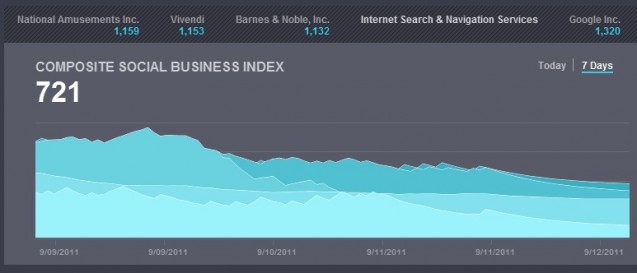
    Social Business Index: Real Time Social Data for Companies

    SEO Hawaii finds this article very interesting. According to this article, One of the a group of companies launched what they called a Social Business Index which measures and ranks companies' social media presence.

    Social Business Index


    Earlier today the Dachis Group launched the Social Business Index, which measures and ranks companies’ social media presence. The Dachis Group, one of the world’s largest social media consultancy firms, received $30 million of Series B funding earlier this year. The Social Business Index (SBI) has an impressive beta participant list that includes companies such as Coca-Cola, Dell, Target, and IBM.

    The scores of major companies continually scroll across the SBI website, displaying data in a similar manner as major financial websites. There are many filters that can be applied to the data, which is updated in “nearly real time” (every 15 minutes). At the time of this post’s publication, the top five businesses on the SBI are: Facebook, Google, NewsCorp, Coinstar, and Wal-Mart.

    According to the Dachis Group website, “Dachis Group’s data services platform analyzes hundreds of millions of signals form tens of thousands of brands through the use of natural language processing, manchine learning, and clustering algorithms in near realtime.” This platform and the SBI can provide businesses with competitive intelligence, benchmark data, and analytics that can be leveraged to improve social media performance.

    Although the Social Business Index is still in its early stages of product development, it is free for companies to register and is a useful tool for the analysis of social media strategies and tactics. The SBI will enable companies to benchmark their social reach before and after launching a social media campaign and thus measure success. However, the advanced features and datasets require a fee.

    The SBI should be useful to businesses wanting to gather competitive intelligence and analyze the effectiveness of social media strategies.

    Social Business Index: Real Time Social Data for Companies

    Good Keyword Research Takes Time

    Have you ever been experience having difficulty finding a keyword suited to for your business? Are you a business owner. If then, this article is very important to you. In addition, SEO Hawaii come up with a good summary of this article. Good Keyword Research takes time according to the author of the below article. Therefore, read this article for a hint so that you could come up with a good and final niche.

    A good business owner believes that it's worth spending some time on the factors that will contribute the most to the success of the business. These are the kinds of things that you'll want to spend the time to do right. If you do business chiefly online, finding and using the right keywords falls into this category. The fact is, if you expect (or hope) to be found via the search engines, or plan to do any online marketing, keywords will play an essential role in your business. As Christine Churchill explains, Almost all online marketing has its foundation in keywords. The words you buy in pa...

    Twitter Unveils Web Analytics Service

    Social Media Consultant found out that Twitter unlike previously has a new tool for their traffic analysis. They reveal the web analytics service so that website promoters could adjust and get a better handle on the outcome of their tweets.

    The new service is the first fruit from Twitter's acquisition of BackType back in July. BackType, you may recall, is the social analytics company behind both BackTweets and Storm, tools which mined Twitter's tremendous flow of data so that website promoters could get a better handle on the effects of their tweets. So how will Twitter's new web analytics service help webmasters? According to Christopher Golda (), co-founder of BackType, the tool will benefit webmasters in three ways. First, it will help them understand how much their website content is shared across Twitter's network. Second, ... 

    Social Media is Sucking the Life Out of My Business!


    SEO Hawaii finds this article for those leaders of their website to really read it. This article as what SEO Hawaii understood about it talks about how do this social media like facebook, twitter, and etc. can help us to our success in finding it easily.

    The single biggest resistance I get when talking to clients about engaging in social media is the amount of time social media requires. Most companies that are not using social media find it overwhelming and difficult to understand. And, they lack the time or resources required to make social media successful for them.

    I'm not going to try to convince you otherwise.

    My company has recently ramped up our own social media efforts and I have to tell you I find it overwhelming and difficult to understand. I lack the time and resources required to really make it successful for us. But as with anything new, you just gotta push through. Pulling the plug would be conceding defeat in an area where a victory is needed.

    Never give up. Never surrender.

    Let's take a look at these common complaints of social media and what can be done to make social media successful.

    Social media is overwhelming

    There are dozens, if not hundreds of places to engage socially online.

    Facebook.

    Twitter.

    Linked In.

    Google+.

    Blogs.

    And that doesn't include the social tracking services, third party tools, posting tools, organization lists and who knows what else I'm missing. Each social service requires it's own level of commitment and interaction that must be actively maintained.

    Social media is difficult to understand

    How, when and where you need to post, engage or communicate isn't always straightforward. It's important to provide value in each stream without creating a "me too" stream in another. Each social platform will reach a different audience with different levels of engagement and that must be taken into consideration.

    A separate strategy for each social platform is required. In order to do it right, you have to learn the nuances of each.

    How often you post, what you say, how you say it and who you connect with are all important in building up your social media presence. Connecting in one stream works differently than connecting in another. Same with engagement. They all have their quirks and you've go to learn each in order to manage them appropriately.

    Lack of time and resources needed to make social media successful

    This is the big one. There is more to social media than writing the occasional blog post and throwing a link to it out on Twitter or Facebook. You have to be actively engaged with your community. Engaged on Twitter, engaged on Facebook, engaged on Linked In, engaged in your blog comments and engaged in other people's blogs.


    Phew! That's a lot of engagement!

    And the most difficult part is very little of this can be done by an outside service. Consultants like us can help you develop a strategy, but it's always best if an actual person from the company handles the engagement. After all, you know your product or services better than anybody else can, and you are uniquely qualified to handle complaints and customer satisfaction.

    Whats the best way to manage your social media campaign?

    That will be different for each company. Not everyone can afford to hire a full-time social media person. But even among those who can and do, it's essential to have someone help organize and build strategy.

    If your in-house person has been managing social campaigns for any length of time and is fully dedicated to social media, then you might have just what you need. But for many businesses, hiring a consultant to either manage, implement or just strategize with can be extremely lucrative.

    Even if you have someone to carry out the plan in-house, it's helpful to have a consultant who can work with you to develop a solid strategy for each social stream and then work with your team to implement it.

    Don't let social media suck the life out of your business

    For many, social media is fun. And it should be. But it's easy to get overwhelmed, throw up your hands and walk away. But this isn't an area where you can concede defeat. While social media can be a pain, and these complaints have legitimacy, you can overcome them. Time, patience and practice make all the difference in the world.


    More and more people are getting social. That's where they get their information, news, pass tips, strategies and recommendations. If you're not engaged with them, someone else is. Your competitors are building brand, answering questions and becoming an authority. What are you doing?

    You may be top in your field, but these things change. It's all a matter of perception. MySpace used to be the top social site, now Facebook is. AltaVisa was once the top search engine, now Google is. K-Mart used to be the top retail store, and you get the picture.

    Things shift. If you don't get ahead of it you'll be shifted out while someone else is shifted in. Any new strategy can be a challenge, but you can learn to use social media to enhance your business (as opposed to sucking the life out of it). 


    Twitter Analytics: Analyze 100 Million Active Users

    Twitter Web Analytics

    In this article, Social Media Consultant come up with a summary that twitter base on what does twitter wanted to emphasize will have already a software that will help them analyze the millions and millions of users which is one of the problem since then.

    With over 100 million active users worldwide, there is little doubt that Twitter is capable of driving large quantities of traffic to all types of websites. Although Twitter provides businesses with the opportunity to share content and drive traffic, it has been difficult to measure the true amount of traffic that Twitter sends to a website. Christopher Golda, the co-founder of BackType and member of Twitter’s product team, said:

    “Twitter is a powerful platform for websites to share their content, and drive traffic and engagement. However, people have struggled to accurately measure the amount of traffic Twitter is sending to their websites, in part because web analytics software hasn’t evolved as quickly as online sharing and social signals.”

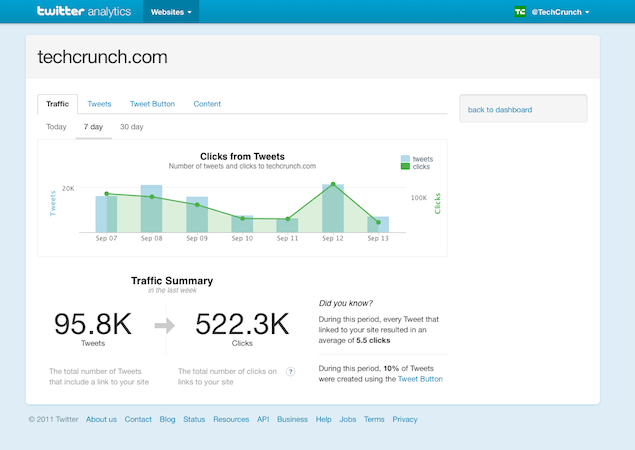
    Twitter Web Analytics, which was driven by the acquisition of BackType in July, will seek to alleviate the problem Golda mentions. It will provide website owners with three key pieces of information:

    1. How website content is being shared on Twitter
    2. The quantity of traffic Twitter is sending to their website
    3. Determine the effectiveness of the “Tweet This” button integration

    Twitter web analytics, which will be available to all website owners in the next several weeks, is currently only available to a small pilot group of Twitter partners. Although Golda did not state an exact timeframe, he indicated that Twitter is committed to releasing Twitter Web Analytics API for developers.

    In addition to the addition of Twitter Analytics, Twitter recently announced the inclusion of promoted tweets within non-followers Twitter streams and the addition of five new languages.

    Twitter Analytics: Analyze 100 Million Active Users

    Twitter Announces Analytics For Tweets, Traffic & Buttons

    "Social Media Consultant Hawaii" shares you an article on how do tweeter and their buttons musst be used.
    This week at TechCrunch Disrupt, Twitter announced Web Analytics to webmasters (and Tweeters) see how their content is being shared and how their buttons are being used.  This new platform integrates fully with the new t.co shortener to help see content distribution. During the presentation it was...

    5 Simple Steps To Stop Wasting Budget With Poor Retargeting

    In this article, you will be learning no to waste your money with poor retargeting. You can gain good knowledge that is applicable to your website just like with SEO Hawaii.
    Is this really another article about retargeting? Absolutely, but with very good reason – whilst marketers think retargeting (or remarketing) is an obvious and established practice, many are still failing to get it anywhere near right, and are actually harming their campaigns by doing it badly. A...

    Site Search Analytics - Pattern Analysis to Improve Your Site

    Site Search Analytics - Pattern Analysis to Improve Your Site

    In this article, SEO Hawaii find it very interesting. It is a new learning for everybody. As a short description about this article, SEO Hawaii together with the reader will learn the pattern analysis which will be one of the component to improve your site. Below descriptions will help you realize how this article will help come up with the pattern analysis that they are talking about.

    Your site search data, the phrases your website users type into your internal site search engine, is data that is swimming with insights into helping to make satisfied customers with your web site.  If you are someone that is responsible for the performance of a site, this is most likely information that you've never looked at and may have not even known existed.  But, you're going to want to become familiar with it because it's about the best place you can go online to learn what your users want.  Read the first post in this series for why.

    Let's start with a major analysis type that we can use with this data to improve performance, pattern analysis.

    Pattern Analysis

    With this type of analysis, you look at what your queries have in common or what's odd about them.  Basically, as the name suggests, any patterns that you can identify when looking at the main phrases being used by your visitors.  If you study these groups, you should be able to gain insights into the content your visitors want and need.  Take a look at these search terms for a minute or two (click for enlarged version)...


    Site Search Terms.png

    In looking at the queries, you can clearly tell this site is in the medical field.  What kinds of interesting patterns do you see?  Here are a couple of my observations...

    • the top query "enter your search term here."  It looks like many visitors are just hitting the search button without entering a query.  Why?  If not, is there another technical reason we're missing here?
    • 3 of the top 25 queries are forms of "log in."  Are people having trouble finding where to login?  We can even throw #24 in this group - "patient portal."  Are patients the ones trying to log in?
    • 2 of the top 25 are "ipad" and "mobile."  Looks like people are going to the site looking for apps.  Are they finding them.  Why are they searching instead of just navigating there?
    • 2 of these terms are forms of "system requirements."
    • "demo, training, certification, support" are all queries looking for assistance with the product.

    I could keep going, but this gives you an idea of the different types of groupings that you will come up with if you just observe what the queries are.  Once you do this, you will start to see patterns emerge that will give insight into what's going on with your visitors.  This will lead you to ask a lot of questions that will start you down the road to finding answers to why searchers are acting the way they are.  That's where the gold is.

    Here are some of the types of patterns you should keep your eyes open for that will help improve your site...

    1. Tonal - How does the language of your visitors and your content match up?
    2. Synonyms - Grouping synonyms allows you to see how popular different subjects are with your visitors and the kinds of words they use to find what they're looking for.
    3. Time-based - You can look at what's important and when to deliver the right content at the right time.  Time plays a huge role in shaping searcher's needs.
    4. Questions - You can cluster queries by the types of questions that are embedded in them to see what is on searcher's minds and how you are delivering it to them.
    5. Answers - You can do the same with types of content they want to find that they're implying in their queries.

    Sometimes thing will jump out at you immediately after you identify a pattern and other times you might have to play with the data a bit.  After you've established patterns and have identified the questions that they spark, it's time to seek out those in your organization that can answer the questions about visitor intent thoroughly.  Those answers will be a helpful guide to improving your web site performance.

    Google Antitrust Hearing: Will Google Be Found Evil?

    The "Social Media Consultant Hawaii" found this news very interesting to everyone that is why it is being re-posted here for everybody's information. As of now, Social Media Consultant Hawaii will be keep updates on this related article for more information regarding this matter.


    Google Antitrust HearingOn Wednesday, former Google CEO Eric Schmidt is expected to testify before the Senate Committee’s antitrust panel and argue that Google does not give preference to its own products. Eric Schmidt, who is the executive chairman of Google, relinquished the chief executive officer position to Larry Page in May. He is expected to say that Google, which currently controls approximately two thirds of search traffic, displays search results on the basis of what is best for users.

    Google, whose share of US search revenues is over 75%, will point out that users have a choice of search engines. Schmidt is expected to claim that Google’s algorithm and extensive user testing determine ranking and that Google is not abusing its web dominance when the search giant ranks certain properties it owns above the competition.

    Testifying for the opposition, Jeremy Stoppelman, co-founder and chief executive of Yelp, is expected to argue that Google is using its monopolistic power adversely to destroy its competition. Although Google tried to buy Yelp in 2009, negotiations with the popular review site were unsuccessful. After the acquisition talks broke down, Google launched Google Places, its own version of Yelp’s review site. Stoppelman will undoubtedly claim that Google copied Yelp’s content and treated Google Places preferentially when it displayed the copied content above Yelp reviews.

    Senator Richard Blumenthal, a Democrat from Connecticut and member of the antitrust subcommittee, said:

    “Google is a great American success story, but its size, position and power in the marketplace have raised concerns about its business practices, and raised the question of what responsibilities come with that power.”

    The hearing has been appropriately named, “The Power of Google: Serving Consumers or Threatening Competition?” On Wednesday, Senator Blumenthal and the rest of the antitrust panel will attempt to determine the answer to that question as well as if Google has violated its own corporate slogan:  “Don’t be evil.”

    Facebook Lists Get Smart With Automation & Suggestions

    Facebook updated their website and added a smart lists on it. The advantage of this Smart Lists according to the SEO Hawaii it will gives you an auto-generation and it covered the groups of family, school, work, and city.

    Today Facebook announced enhancements to lists, including the release of “smart lists.”  This new functionality helps to auto-generate lists for users, a task that was somewhat arduous in the past. Smart Lists The new smart list feature gives users assistance in list creation. Facebook...


    Why Social Must Be Part Of Your Mobile Strategy

    In this article SEO Hawaii finds out that Social Media can be a great help to your website as a part of your mobile strategy. As we knew that many people nowadays are more frequently using mobile phones rather than desktop.

    Let me start this piece by throwing a few stats out there: Mobile Over 550,000 Android phones are activated each day (worldwide). In the UK, 45% of Internet use is done on mobile devices. There are more than 3m mobile Internet users in London alone. In the UK, there are more than 15,000,000...